
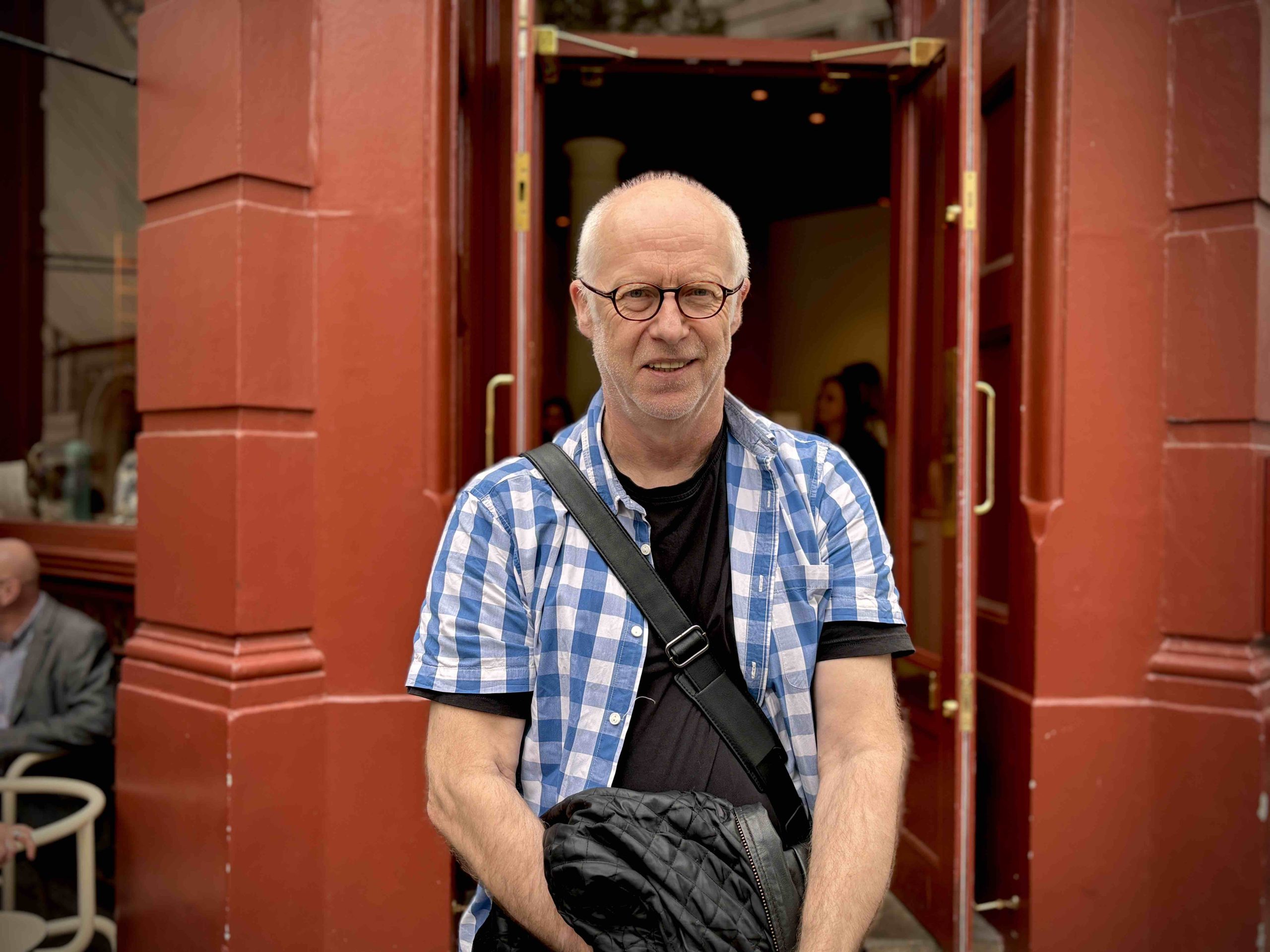
Rod Judkins is a best-selling author, lecturer, and artist known for his work on creativity and innovation.
He has lectured on art, design, and creative process at Central St Martin’s College of Art for over twenty years.
Rod has written several books that explore how creative thinking can be used across everything that humans do. His books include The Art of Creative Thinking, Change Your Mind, Make Brilliant Work and Ideas Are Your Only Currency.
Haniah: The creative world is changing so quickly and it is hard to know exactly how things will pan out. What should creatives do to future proof themselves?
Rod: I don’t want to train my eighteen and nineteen year old students with things that will be out of date in ten years.
Many of the tools that we use now will be out of date in ten years. But creative thinking will still be important.
Creative work will still need to resonate with humans. That is why creative thinking is so important.
Take books and publishing as an example. AI might take care of the layout and crafting. Leaving you to focus on creating a personal style for the look and feel of your book that better connects with your human reader. Everyone might be able to publish books in their own individual style. Compare this to now – where almost all books have almost the same layout.
“Make your work more you!” That might be how creatives need to think in the future.
Haniah: How did you start the 100 Design Projects course at Central Saint Martins?
Rod: It came from the learning that short, fast projects would help creatives to think better.
This was a big contrast to the normal longer projects where students spend a lot of time in research and execution.
Shorter time frames means you are forced to think in a very different way. Forcing you to think in ways you wouldn’t think if you had a lot of time.
The 100 Design Projects course is designed to help anyone apply creative thinking to whatever they are doing.
The course is about coming up with ideas fast – a form of thinking that you can apply to any project in the future. Every time the project is run, two to three projects get added or changed.
Haniah: Tell us about your new book “Lie Like A creative”
Rod: The founding truth of Lie Like a Creative is that artists and designers communicate and get an idea across.
In advertising, a creative will often have to communicate an idea in thirty seconds. The idea needs to stick in people’s minds in that short a time.
Many artists and designers have become experts in this skill of effectively getting ideas across to other humans.
I want my book to appeal to a wider audience – who have not had the years of experience in this type of communication that artists, designers, film makers and other creative professionals have.
Picasso said: “We all know that Art is not truth. Art is a lie that makes us realise the truth, at least the truth that is given us to understand.”
One important idea is that visuals help so much in communicating ideas. Our brains are tuned to understand visuals.
There is a part in my new book about Florence Nightingale – where she realises that more soldiers were dying from infections than from the war they were fighting in. She took her findings to the generals and they didn’t do anything. She went back and presented the information in a type of pie chart – so she could show visually that more soldiers were dying from infections versus war. This time the generals understood and decided to make a change.
Another important idea is that it is important that just one thought is being communicated. Because that’s all people can remember. And then you have a chance of making that message stick.
Haniah: How can people grow their creative abilities?
Rod: Try something new every day. Being creative every day is the best way to become more creative.
I did an exercise with doctors once where I asked them to sit together after a surgery.
I asked them to be imaginative about the instruments that they used, could they be designed better?
Could the sequence of actions during the surgery be different?
Could we change the material used to make the tools? Could the sizes of the tools be different? Could the tools be made out of ice and so they could dissolve (like how dissolving stitches now dissolve)? What if there was a spray on skin for skin burns?
I encouraged them to be playful and imaginative. That’s when breakthrough ideas can be born.
Haniah: How can someone be a better creative leader?
Rod: I think the best way to inspire and motivate creative teams is to lead by example. Be a tutor. Be open minded.
Don’t be precious about yourself – being precious about yourself creates the wrong atmosphere. Be humble. Be prepared to make a fool of yourself.
Allow your teams to question you. Make them see that it is safe to criticise you. You can’t take yourself too seriously.
Haniah: What do people learn from your books?
Rod: Creative thinking is the core of my work. And creative thinking can be used by anyone and can be used anywhere.
The books talk a lot about how creative thinking is used by artists, engineers and scientists.
In one case, my work brought me to a group of medical students. They wanted to be able to think creatively. When the workshop started the medical team was just being given art projects and I could see they were not getting anything from it. I realised that achieving this was harder than I thought. For example you can’t ask medical students to do a collage. There had to be a link to what they do. To speak their language – so it wasn’t separate from what they were doing.
When they got a relevant project, their creativity was unlocked. The medical team had an innovative pill for liver disease. The pill had to be taken every four hours. But that meant patients had to get up in the middle of the night to take it – so patients weren’t taking it as needed. The hospital gave the patients comprehensive instructions to go with the pills – but they were boring. So the medical team decided in this creative workshop to turn it into a game. Gamifying the pill via an app was a game changer as it turned a difficult task into a fun one. It became a competition between patients where they won points for taking the pills on time.
Haniah: How did you find going back to academia from the commercial world?
Rod: I joined Central Saint Martins to cover someone who was going on maternity leave. Initially I was reluctant as the university world seemed very different from the commercial world. It was a shock. But then I realised how freeing it was. Art school is a place where you can be free to be. Free to experiment. Free to push boundaries. All within the safe confines of the art school.
The students I teach are mostly 18 or 19 years old. It is surprising that they are already fixed in their thinking. They are scared of looking bad – of making fools of themselves. So my job is to create an atmosphere where the creative students feel free. This is one of the hardest but most important jobs. Asking creative students to suspend their judgement – to wait till the end to see what’s worked and what hasn’t worked.