
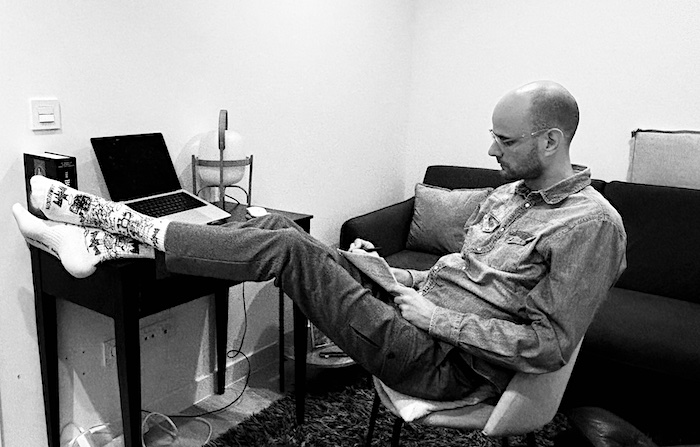
Luis is a conceptual artist and an incredible advertising creative. Luis is now based in Barcelona.
He talks to us about the future of advertising.
Haniah: What are your thoughts on how new technologies will change advertising?
Luis: I think any tool can enhance or limit you. So it depends on how you use a tool. If a tool is being used because of laziness or in looking for a quick answer, then I don’t see it as something that can enhance the potential of creativity. But if you use it just as an extra brain then that is a good use.
You still need someone to choose and pick what’s the right thing and to filter the results of AI. In the end you are like a curator of machines.
A client could possibly type into an AI to give them the best layout for something but do they have the knowledge to curate it, to know whats the best option/outcome for them. You need a specialist for it, just like you need a good cook who uses a knife in order to chop something in the best way possible. Or like you have a pan but do not know how to fry an egg, then the pan is not much use to you. You have the tools but you need to know how to use them.
You need to have the right mindset as well. As creatives we can use tools and explore the limits of things. We don’t get satisfied from the first answer. We always push push push – keep digging. The machine is there but you need the creative to go further and offer more. The people building the tools are also creative.
I use AI a lot to visualize concepts. Before when you would need to do a storyboard, you needed an artist to help you draw but nowadays you can just get a first attempt at storyboarding quite quick, even when crafting a look and feel for a concept. So in this sense, it’s very useful to use AI to start generating concepts or the storyboards. It saves you time trying to visualise a concept. So it is a lot more efficient.
Before when you had an experimental thought, you needed to brief a producer or 10 people to work out to see if something is even possible but now with AI you can do all that yourself. You have less limits and no one to say no this is not possible. AI saves you costs by allowing you to visualise and experiment until you are confident – then you can take a more finished idea to a client in a much shorter time frame. Like a maqueta (mock), you create a mock version of the project before doing the project itself. They are more organic, experimental and less polished.
Haniah: It is getting harder and harder to get consumers’ attention. How would you advise brands to do this?
Luis: I think that’s the biggest challenge we have right now. There’s so much noise. That’s the number one problem surfacing for brands and for creatives as well.
I could say I don’t think there is a formula. Of course, you need to deserve that attention. That’s the most important thing. I know some brands are like, let’s do this trend because this trend is popular on social media, so now everybody will engage with us because we are jumping on the trend. But maybe you are too late to that trend. And maybe it doesn’t feel natural, so this way at the end there is no recipe.
I think you just need to do something that has value in terms of entertainment, information or emotion. It really needs to have a value at some point. You need to come from a place that is natural and real. If it’s too false, I think people notice when you are trying to be something you are not. As a brand you should be cool and be loud if that’s who you are as a brand.
So, the most important thing is for a brand to be as authentic as you can. A good example of this is the brand Liquid Death.They are bizarre from the start. They are not pretending to be crazy, that’s who they truly are. So when they do something bizarre, you believe it.
Haniah: How is technology changing advertising in Spain?
Luis: Definitely we are not a leading market when it comes to technology like the US or some other countries. But I think yes, we’re embracing technology. Nobody is really scared of technology in that sense. but perhaps we’re a bit slower in going full on. Everybody knows this is important and a revolution, but we’re not fully embracing it yet or even providing the necessary training.
If we take a step back and look at the culture, it is a bit laid back. We are letting everyone else do cartwheels and by the time it’s fully figured out, we will embrace it fully. There is a theory that says that cold countries are where people innovate more, because you spend more time indoors and you need to be stuck in between four walls and keep going until you produce something innovative. We are more social and if you’re socializing, perhaps there’s not much time for innovation. Perhaps innovation needs a little bit more blood, sweat, tears and darkness to make that happen versus a beautiful sunny day.
Haniah: What would be your advice to young creatives who are stepping into the creative industry?
Luis: My advice would be that whatever you do, be hungry. Want to do something that will even amaze and surprise yourself, and will excite others. You should feel passionate about what you do and this is what I think a young creative person must have. If you are not passionate, then you are not in the right industry. If you are self-driven everything will come naturally, you will embrace technology, you will research, you will try things, you will just go beyond the expected or beyond what the first answer.
Haniah: What would be your advice to brands who want to be future ready?
Luis: Everybody is scared of failing. Fear of failing is what will make you not embrace the future. You need to take risks and surprise yourself. Most brands are in ‘the’ safe space. Things won’t move forward and they will miss opportunities. I know brands follow a structure and don’t want to try new things. Small brands take risks and try new things. Maybe the big brands need to learn from the smaller brands. They are flexible, agile and not afraid of risks. Most big brands will embrace change in little portions.If you want impact and future readiness you have to take risks.
If we think of brands like a person, if you try new things that doesn’t mean you are a different person. It just means you are trying new things. Why don’t brands try this? Go far, then pull back a bit. If you play it safe and don’t innovate you will stay in the same place while the new brands will be more relevant. Find the balance between evolving but keep bits of your personality. Just don’t get stuck because nobody likes that old smell.
A little about Luis and his creative approach
Haniah: How did you get into advertising?
Luis: I got into advertising in unexpected ways because I came from a fine arts and experimental background. From there I got interested in the world of design. I met Till Hohmann who was very interested to have a design specialist in his team. He felt it was one of the profiles that was lacking in advertising agencies. Because designers have a thinking process that is different from Art Directors. Art directors are thinking about big ideas but the detail for the craft comes from designers.
Advertising was a new world for me because I went from crafting things to also communicating things. Design and communication clicked for me and I got trapped into this world of advertising. I couldn’t escape from it.
Haniah: How do you balance your focus between ideas and design?
Luis: Depends on the media. I mean, if you’re doing a campaign that is focussed on content or an above-the-line (ATL) campaign, perhaps the design part is a bit diluted. I would say with other media like out of home (OOH) or branding definitely the design skills can play a big part in the impact and quality of the final creative output. If you have a solid base in design it strengthens everything else. For example if you are working on a film brief, your design base allows you to put some order in the chaos. To come up with a rational way of expressing the ideas.